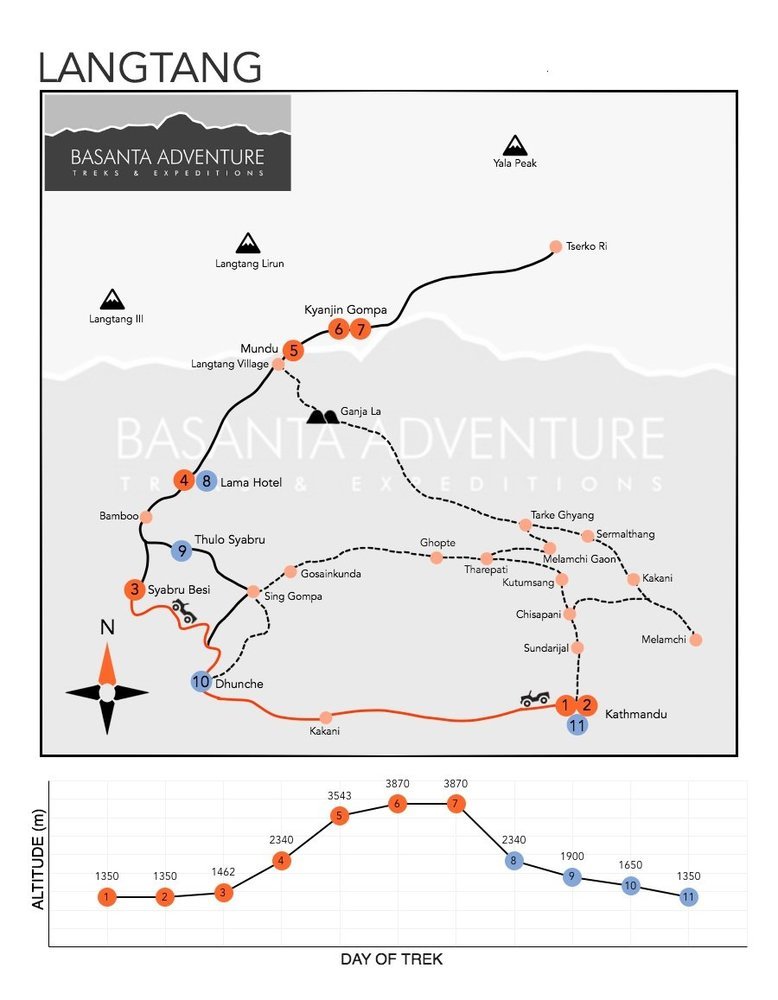
Trek Name: Langtang Trek
Trek Code: Not specified
Grade: Moderate
Max Elevation: 4,984m / 16,352ft
Accommodation: Hotel / Lodge / Teahouse
Meal: Not specified
Transport: Road Transfer
Trek Days: 07 Days
Total Days: 12 Days
The 12-day Langtang Trek explores one of Nepal’s closest Himalayan valleys through rhododendron forests, traditional Tamang settlements, rebuilt Langtang Village, and Kyanjin Gompa. The journey combines Buddhist culture, changing alpine landscapes, spectacular views of Langtang Lirung, and an optional climb to Tserko Ri at 4,984 m, offering a rewarding Himalayan adventure without requiring domestic mountain flights from Kathmandu.
Overview of the Langtang Trek
The 12-day Langtang Trek takes you into the heart of Langtang National Park, directly north of Kathmandu near the Tibetan border. The journey follows the Langtang Khola from Syabrubesi through dense forest, traditional Tamang settlements, Langtang Village, Mundu, and eventually Kyanjin Gompa at approximately 3,870 m.
The route is considerably quieter than Everest Base Camp and many popular Annapurna treks, yet the mountain scenery remains impressive. Langtang Lirung dominates the valley while Gangchenpo, Yala Peak, Dorje Lakpa, Langshisa Ri, and several surrounding Himalayan peaks appear as the trail climbs higher.
One of the main highlights is the optional hike to Tserko Ri at approximately 4,984 m. It is the highest point of the journey and provides a sweeping panorama across the upper Langtang Valley and surrounding snow-covered mountains.
The trek also provides a close look at Tamang culture. Buddhist monasteries, mani walls, prayer wheels, chortens, yak pastures, traditional settlements, and local teahouses remain part of everyday life along the route.
Langtang Village adds another important dimension to the journey. The original settlement was devastated during the 2015 Nepal earthquake, and today's rebuilt village reflects the strength and resilience of the local community.
The Langtang Trek is considered moderate. Most trekking days involve approximately 4 to 7 hours of walking on forest trails, rocky paths, stone steps, and mountain tracks. No technical climbing is required, although the optional Tserko Ri hike demands good fitness and proper acclimatization.
Unlike Everest trekking, there is no domestic mountain flight. The trailhead at Syabrubesi is reached by road from Kathmandu, making Langtang one of Nepal's most accessible high Himalayan trekking regions.
Best Time for the Langtang Trek
The best time for the Langtang Trek is during spring from March to May and autumn from late September through November.
Spring brings gradually warmer temperatures and colorful rhododendron forests. March remains colder at higher elevations, while April usually offers stable weather, flowering forests, longer daylight hours, and clear mountain mornings.
May is warmer, although afternoon clouds become more common as Nepal approaches the summer monsoon.
Autumn provides some of the clearest mountain visibility of the year.
September marks the transition out of the monsoon, while October generally offers dry trails, comfortable daytime temperatures, and excellent Himalayan views.
November remains an excellent trekking month but becomes considerably colder around Kyanjin Gompa and Tserko Ri.
Winter trekking is possible with suitable cold-weather equipment, although snow may affect higher viewpoint hikes.
The monsoon season from June through August brings heavy rainfall to the lower valley. Forest trails can become muddy and slippery, while landslides may affect the road between Kathmandu and Syabrubesi.
For most trekkers, March to May and October to November provide the most reliable conditions.
Permits Required for the Langtang Trek
The Langtang Trek takes place inside Langtang National Park, so every trekker requires a Langtang National Park Entry Permit.
Trekkers must also obtain the applicable TIMS Card and follow Nepal's current trekking regulations regarding licensed trekking guides.
Basanta Adventure arranges the necessary trekking permits and documentation before departure.
Permit fees and trekking regulations can change, so the final requirements are reconfirmed when the trip is booked.
Why Choose Basanta Adventure for the Langtang Trek?
Basanta Adventure has been organizing Himalayan treks and tours since 1998, giving our team decades of practical experience across Nepal's major mountain regions.
Over the years, we have led numerous journeys through the Annapurna region, Everest, Langtang, and other remote parts of Nepal. These years of field experience have taught us that a successful Himalayan trek depends on much more than simply knowing the trail.
Walking hours, altitude gain, accommodation, road conditions, weather, porter arrangements, permits, trail changes, and emergency planning all need to work together.
The Langtang Trek may appear straightforward because the trailhead can be reached by road from Kathmandu, but reliable logistics remain essential.
The road between Kathmandu, Dhunche, and Syabrubesi can be affected by construction, rainfall, landslides, or traffic. Teahouse accommodation must also be coordinated in smaller settlements such as Lama Hotel, Mundu, and Kyanjin Gompa.
Our operations team manages transportation, permits, trekking staff, porter support, accommodation, and day-to-day coordination so the journey runs as smoothly as possible.
Our decades of experience leading treks through the Annapurna region have also shaped the way we approach altitude and pacing.
A Himalayan trek should not become a race.
Kyanjin Gompa sits at approximately 3,870 m, and the optional Tserko Ri hike climbs close to 5,000 m. Our guides maintain a comfortable walking pace and monitor how trekkers respond as the elevation increases.
The decision to attempt Tserko Ri depends on weather, trail conditions, fitness, and individual acclimatization.
The safety and wellbeing of trekkers always come before reaching a viewpoint.
Basanta Adventure is also an ISO-certified trekking company.
Our ISO certification reflects our commitment to professional trip management, reliable operating systems, service consistency, and organized delivery.
We also follow sustainable trekking policies across the Himalayan regions where we operate.
Langtang National Park protects sensitive forests, wildlife habitat, alpine landscapes, and local communities. Our guides encourage responsible waste disposal, reduced unnecessary plastic use, careful consumption of water and energy, and respectful behavior around villages and religious sites.
Wildlife should also be observed responsibly.
Langtang National Park is known as an important red panda habitat, but sightings are rare and should never be treated as guaranteed.
Animals should never be chased, fed, disturbed, or approached simply for photographs.
Supporting the local economy is another important part of responsible trekking.
The Langtang Valley was deeply affected by the 2015 earthquake. Staying in locally operated teahouses, purchasing meals and services locally, and employing Nepali trekking staff help ensure tourism continues to benefit the communities living along the route.
Beyond Nepal, Basanta Adventure is also recognized for its extensive experience organizing Tibet tours and expeditions.
Our decades of work in Tibet have given our team broad experience in remote Himalayan logistics, high-altitude travel, permit management, transportation coordination, and acclimatization.
Those same operational principles strengthen the way we manage treks in Nepal.
Careful planning, dependable logistics, experienced guides, realistic itineraries, responsible trekking practices, and respect for mountain conditions remain central to every Basanta Adventure journey
What is included in the tour
Kathmandu Portion:
- 3 nights in reputed 3 star Hotel on BB basis as per the itinerary in Kathmandu
- Half day guided sightseeing tour of Kathmandu
- 1 professional English speaking guide
- Private transportation during sightseeing
- All entrance fee during sightseeing
Transportation:
- Private vehicle to and from trek initiation point.
- All the necessary airport transfers as per the itinerary
- Private Transportation: Kathmandu – Syabrubesi and Dhunche – Kathmandu
Trek Portion:
- Twin sharing accommodation as per the itinerary in lodge en-route on EP (room only) basis.
- Langtang National park fee
- TIMS Card
- Professional licensed holder Trekking guide
- Assistant Guides as per number of clients
- Necessary Porters (weight max. 12 kg per clients)
- Insurance for Nepali staffs
- Necessary equipment for trekking staff
- Guide and porter daily allowance
- Emergency medical kit box
- Trekking kit bag
What is NOT included in the tour
- Nepal Visa fee
- Any meals (Breakfast, Lunch, Dinner and Tea/Coffee) during trek
- Travel insurance (must cover expenses of rescue service including helicopter)
- Personal Gears: ( all trekking gears are easily available on rent and buy in Kathmandu)
- Lunch and dinner in Kathmandu
- Liquor beverages (soft and hard drinks)
- Expenses of personal nature e.g. laundry, phone call etc.
- Gratuity for staff
- Expenses incurred due to unforeseen circumstances
- Services not mentioned herein
- Trek through Langtang National Park, an important Himalayan habitat for red pandas, Himalayan tahr, langur monkeys, and diverse birdlife.
- Reach Kyanjin Gompa at approximately 3,870m beneath Langtang Lirung and surrounding peaks.
- Make an optional ascent of Tserko Ri at approximately 4,984m for panoramic views across the upper Langtang Valley.
- Experience Tamang villages, Buddhist monasteries, mani walls, chortens, prayer wheels, and local mountain hospitality.
- Walk through rebuilt Langtang Village and learn about the community’s recovery after the 2015 earthquake.
- Experience landscapes ranging from river valleys and bamboo forest to rhododendron woodland and open alpine terrain.
- Trek through Thulo Syabru, another traditional Tamang settlement near the end of the route.
- Reach the Himalayan trail entirely by road from Kathmandu, without depending on domestic mountain flights
Day 1Arrival in Kathmandu and Transfer to Hotel, Elevation: 1,350 m/4,429 ft
+
Arrival in Kathmandu and Transfer to Hotel, Elevation: 1,350 m/4,429 ft
Arrival in Kathmandu greeted by Basanta Adventure representative and transferred to Hotel which is usually a walking distance to any good restaurants and shops. We will be given a short briefing on hotel facilities and safety as well as a short introduction to the area. Next day there will be a comprehensive trip briefing. O/N in Hotel at Kathmandu (BB)
Day 2Trek Briefing and Half-Day Kathmandu Sightseeing
+
Trek Briefing and Half-Day Kathmandu Sightseeing
After breakfast, trek briefing will take place around 9 am. All aspects of gear and conditions are discussed to make sure you are fully prepared for the trip, introduce guide and any last-minute questions would be answered. We then visit Boudhanath, also known as little Tibet. Then we visit Pasupatinath one of the revered holy temple of the Hindus, this temple is also known for its cremation ceremonies that take place next to the holy river Bagmati. O/N in Hotel at Kathmandu (BB)
Day 3Drive from Kathmandu to Syabrubesi, 1,500 m/4,921 ft, Distance: Approx. 120 to 130 km, Duration: 7 to 9 Hours
+
Drive from Kathmandu to Syabrubesi, 1,500 m/4,921 ft, Distance: Approx. 120 to 130 km, Duration: 7 to 9 Hours
This morning we'll drive on a northern highway that twists and climbs over mountain ridges to the Trisuli valley for lunch and on to Syabru village for the overnight. The journey will take 8-9 hours through picturesque landscapes, mountain scenery and local villages. From Syabru we'll have magnificent views of Mt. Ganesh Himal, Manaslu and Mt Kerung of Tibet. We'll relax tonight at a local teahouse. O/N in Lodge at Syabrubesi
Day 4Trek from Syabrubesi to Lama Hotel, 2,470 m/8,104 ft, Distance: Approx. 11 to 12 km, Duration: 5 to 6 Hours
+
Trek from Syabrubesi to Lama Hotel, 2,470 m/8,104 ft, Distance: Approx. 11 to 12 km, Duration: 5 to 6 Hours
After breakfast we start to walk own our pace and the trail ascends for around two hours through the forest followed by a climb of about an hour to reach Bamboo village (1,850m/6,068ft) where we'll stop for lunch. This forested path with well stabilized trails and following the upstream and can be seen birds life around the bushes. Bee hives hanging on a cliff are another attraction for the visitors. From here we'll again steeply climb through the bamboo forest to reach the Lama Hotel where we'll rest and overnight at a local teahouse. O/N at Guest House in Lama Hotel
Day 5Trek from Lama Hotel to Mundu via Langtang Village, 3,540 m/11,614 ft, Distance: Approx. 13 to 14 km, Duration: 6 to 7 Hours
+
Trek from Lama Hotel to Mundu via Langtang Village, 3,540 m/11,614 ft, Distance: Approx. 13 to 14 km, Duration: 6 to 7 Hours
We continue ascending from Lama Hotel and enjoy the mountain landscape with abundant waterfalls. As we reach the green meadows of Ghoda Tabela, we begin to see the white peaks of the Langtang range. Our trail continues to climb up the widening valley, passing a few temporary settlements used by herders. We pass a Buddhist monastery before reaching the Langtang village which was affected by the April 2015 earthquake. We continue on our trail to Mundu. O/N at Lodge in Mundu (EP)
Day 6Trek from Mundu to Kyanjin Gompa, 3,870 m/12,697 ft, Distance: Approx. 5 to 6 km, Duration: 4 to 5 Hours
+
Trek from Mundu to Kyanjin Gompa, 3,870 m/12,697 ft, Distance: Approx. 5 to 6 km, Duration: 4 to 5 Hours
After breakfast, we will start our journey to Kyangjin Gompa, a principal monastery of the region. We pass by water mills, prayer wheels, chorten, with sacred mounds of rocks with inscriptions carved on them. We also pass by the largest Mani wall in Nepal, made from stone with prayers written on them. After the short trek, we spend the rest of the afternoon exploring the Buddhist shrine in Kyangjin Gompa and surrounding areas with the amazing views of the mountains. O/N at Lodge in Kyangjin Gompa (EP)
Day 7Acclimatization Day and Hike to Tserko Ri, 4,984 m/16,352 ft, Distance: Approx. 8 to 10 km Return, Duration: 6 to 8 Hours
+
Acclimatization Day and Hike to Tserko Ri, 4,984 m/16,352 ft, Distance: Approx. 8 to 10 km Return, Duration: 6 to 8 Hours
We spend the whole day exploring Tserko Ri which will also help us acclimatize to the high altitude. We begin early in the morning. The trail passes through yak pastures before ascending to Tserko Ri. The sunrise view from the top of Tserko Ri is extraordinary. We get back to Kyangjin Gompa by late afternoon and explore the beautiful monastery while enjoying views of the Himalayas, glaciers, birds and yaks. Our guide will organize a prayer and offer Lungta (Prayer flag) for good health and happiness for all the members. O/N at Lodge in Kyanjin Gompa
Note: Offer Lungta or prayers flag (printed prayers for the peace and good health/happiness) together with our Guide. Offering prayer flag in high passes and sacred sites is believed to bring good fortune and long life in Buddhist culture.
Day 8Trek from Kyanjin Gompa to Lama Hotel, 2,470 m/8,104 ft, Distance: Approx. 18 to 20 km, Duration: 6 to 7 Hours
+
Trek from Kyanjin Gompa to Lama Hotel, 2,470 m/8,104 ft, Distance: Approx. 18 to 20 km, Duration: 6 to 7 Hours
This morning we'll retrace our steps somewhat as we head back from the Gompa. We have an easy downhill and pleasant walk through the rhododendron forest to Lama Hotel where we'll rest for the night before continuing our journey tomorrow for the Thulo Syabru village. O/N at Lodge in Lama Hotel (EP)
Day 9Trek from Lama Hotel to Thulo Syabru, 2,210 m/7,251 ft, Distance: Approx. 12 to 15 km, Duration: 5 to 6 Hours
+
Trek from Lama Hotel to Thulo Syabru, 2,210 m/7,251 ft, Distance: Approx. 12 to 15 km, Duration: 5 to 6 Hours
Today our trail leads again through bamboo & rhododendron forest where we may see the local wild boar as well as other animal and birdlife on the route to Thulo Syabru. En route we'll have marvelous views of Mt Ganesh Himal, so close it seems like it's beside us. Firstly easy downhill follows the river bank but last part steeply uphill for couple of hours to get to the village. O/N at Lodge in Thulo Syabru (EP)
Day 10Trek from Thulo Syabru to Dhunche, Approx. 2,000 m/6,562 ft, Distance: Approx. 7 to 10 km, Duration: 4 to 5 Hours
+
Trek from Thulo Syabru to Dhunche, Approx. 2,000 m/6,562 ft, Distance: Approx. 7 to 10 km, Duration: 4 to 5 Hours
This morning after breakfast we'll be ready for trek onwards to Dhunche. This is quite pleasant walk through the forested path and some old Tamang village's takes to get 4-5 hrs. After arrival in Dhunche, rest of the time explores the town which is headquarters of Rasuwa district. This will be our last night with your trekking crew except trekking Guide, this is best time to tip the staff (not compulsory but it’s a customary), an impromptus little ceremony and always enormous Sherpa smiles. Then something of a party is inevitable. Try local drink called “Rakshi”, please be aware; it does not taste good and is very strong. O/N at Lodge in Dhunche (EP)
Day 11Drive from Dhunche to Kathmandu, Distance: Approx. 115 to 120 km, Duration: 6 to 8 Hours
+
Drive from Dhunche to Kathmandu, Distance: Approx. 115 to 120 km, Duration: 6 to 8 Hours
Today we'll have an early morning drive to Kathmandu. It will take 8-9 hrs. We'll reach Kathmandu late afternoon then enjoy our night at Thamel. Upon arrival, any hired gears will be collected and your international flight tickets will be distributed. ON at Hotel in Kathmandu. (BB)
Day 12Holiday Extension or Transfer to Airport for Final Departure
+
Holiday Extension or Transfer to Airport for Final Departure
Your 12-day Langtang Trek officially concludes today.
Depending on your international flight schedule, one of our representatives will transfer you to Tribhuvan International Airport for your onward journey.
We recommend allowing sufficient time for airport check-in and departure procedures.