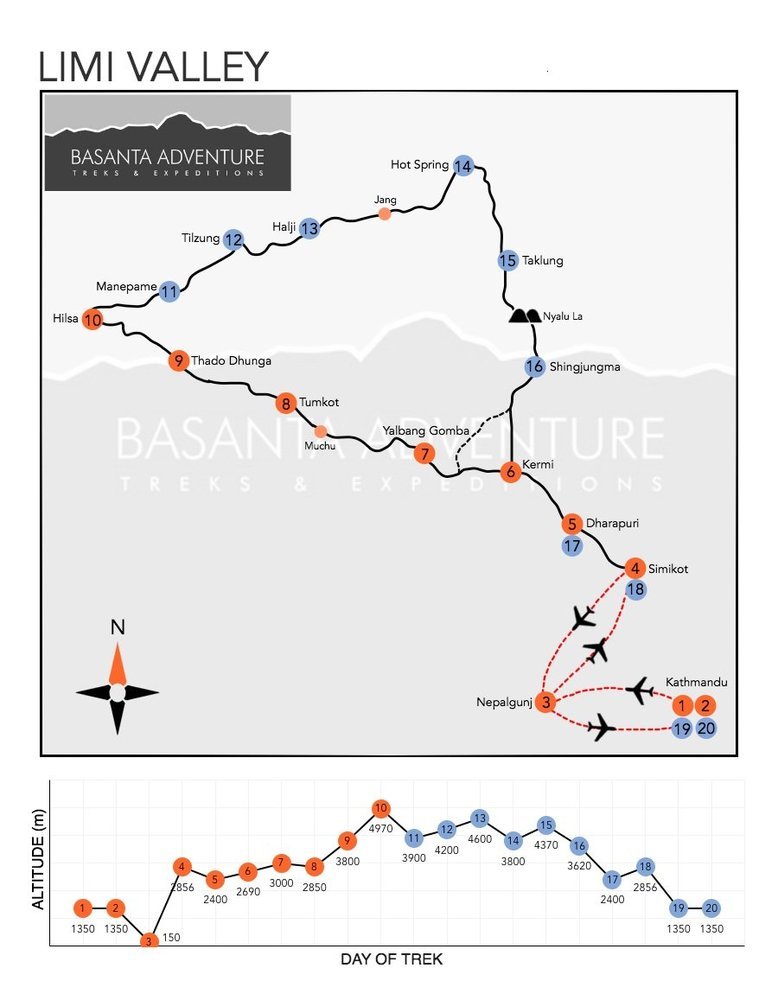
Trip Facts
- Trek Name: Limi Valley Trek
- Trek Code: BATE NEP 014
- Destination: Limi Valley, Humla, Karnali Province, Nepal
- Trek Grade: Strenuous / Adventurous
- Maximum Elevation: Approximately 4,940m / 16,207ft at Nyalu La Pass
- Nara La Pass: Approximately 4,620m / 15,157ft
- Accommodation: Hotel, Guesthouse, and Tented Camp
- Meals: Bed and Breakfast in cities; Full Board during the trek
- Transportation: Domestic Flights and Private Vehicle
- Trekking Duration: 14 Days
- Total Duration: 21 Days
- Starting Point: Simikot, Humla
- Ending Point: Simikot, Humla
- Trek Style: Fully Organized Camping Trek
- Trek Availability: Available on Request
Limi Valley Trek Summary
The Limi Valley Trek is a remote Himalayan journey in Humla District, in the far-western region of Nepal. Located near the Nepal-Tibet border, Limi Valley is known for its traditional Tibetan-influenced villages, ancient monasteries, high mountain passes, and landscapes that remain relatively untouched by mainstream tourism. The trek follows sections of historic trading routes that once connected communities in Nepal with Tibet.
Beginning in Simikot, the administrative center of Humla, the route follows the Karnali River through traditional settlements such as Dharapuri, Kermi, Yalbang, and Tumkot. It then climbs toward Nara La Pass at approximately 4,620m before descending to Hilsa near the Nepal-Tibet border. From Hilsa, the trail enters the remote Limi Valley, passing Manepeme, Til, Halji, and the surrounding high-altitude settlements.
The cultural experience is one of the defining features of this journey. Limi Valley is home to three traditional villages, Til, Halji, and Jang, where Tibetan Buddhist traditions, stone houses, agricultural practices, and community life remain closely connected to the surrounding Himalayan environment. Halji is particularly known for Rinchenling Monastery, an important Buddhist heritage site traditionally associated with the great translator Rinchen Zangpo.
The return route crosses the spectacular Nyalu La Pass at approximately 4,940m, the highest point of the trek. From the pass, the trail descends through high-altitude landscapes toward Shingjungma and Kermi before returning to Simikot. On clear days, the wider region offers views of Mount Saipal, Mount Api, Mount Kailash, and other Himalayan peaks, depending on visibility and the exact viewpoint.
The 21-day Limi Valley Trek includes 14 days of trekking, domestic flights between Kathmandu, Nepalgunj, and Simikot, hotel and guesthouse stays, and organized camping in remote sections. It is suitable for experienced trekkers seeking a demanding journey through one of Nepal's least-visited Himalayan regions.
Responsible Trekking in Limi Valley
Limi Valley is a culturally and environmentally sensitive destination. Its remote communities, traditional settlements, and high-altitude habitats require respectful travel practices.
Carry reusable water bottles, reduce single-use plastic, and dispose of waste properly. Do not leave rubbish along the trail, near rivers, or at campsites. Follow the guidance of your trekking team when camping and traveling through local settlements.
Respect monasteries, prayer flags, mani walls, and other religious structures. Ask permission before photographing residents or entering private property. Avoid disturbing wildlife and do not collect medicinal plants or other natural materials.
Responsible trekking helps protect the region's cultural heritage and natural environment while supporting local communities.
Limi Valley Trek Difficulty
The Limi Valley Trek is a strenuous and remote Himalayan adventure. It involves long walking days, steep ascents and descents, high-altitude passes, and extended periods away from developed settlements. The route crosses Nara La at approximately 4,620m and Nyalu La at approximately 4,940m.
Trekkers should have good physical fitness and previous experience with multi-day trekking, preferably at high altitude. Several sections involve walking for six to eight hours, while the crossing of Nyalu La requires an early start and a long day over exposed mountain terrain.
The remoteness of the region adds to the challenge. Accommodation and facilities are limited, mobile communication can be unreliable, and access to medical assistance is restricted. Weather conditions can also affect the trail and domestic flights to and from Simikot.
Prepare with regular hiking, uphill walking, stair climbing, and cardiovascular training before departure. Follow a gradual walking pace, stay hydrated, and inform your guide immediately if you experience symptoms associated with altitude sickness.
Best Time for the Limi Valley Trek
The best time for the Limi Valley Trek depends on snow conditions at the high passes, weather in Humla, and the availability of domestic flights. Spring and autumn are generally suitable trekking seasons, while summer can also be considered because Humla lies in the rain-shadow region of the Himalaya.
Spring (April to May)
Spring offers gradually warming temperatures and generally suitable conditions for trekking. The lower valleys become greener, while higher mountain areas may still have snow. Conditions around Nara La and Nyalu La should be checked before departure, especially early in the season.
Summer and Early Autumn (June to September)
Humla lies in the rain-shadow region of the Himalaya, so some parts of the area receive less monsoon rainfall than southern Nepal. This can make summer trekking possible. However, flight disruptions, changing weather, and snow conditions at the high passes remain important considerations.
Autumn (October to November)
Autumn generally offers clear mountain views and cooler temperatures. It is a popular period for high-altitude trekking in western Nepal. Nights can become very cold, particularly around Manepeme, Talung, and the high-pass campsites.
Winter (December to March)
Winter is generally not recommended for the standard Limi Valley itinerary because heavy snowfall and freezing temperatures can make the high passes difficult or inaccessible. Flight operations may also be affected by weather.
Culture and Traditional Villages of Limi Valley
Limi Valley is one of the most culturally distinctive regions of Humla. Its communities have strong historical, linguistic, and religious connections with Tibet. The three principal villages of Til, Halji, and Jang preserve traditional settlement patterns, stone houses, Buddhist practices, and local agricultural traditions.
Til Village
Til is one of the traditional settlements in Limi Valley. Its stone houses, cultivated fields, and mountain surroundings provide an insight into the daily life of the local community. The village reflects the Tibetan-influenced culture that characterizes much of northern Humla.
Halji Village
Halji is particularly well known for Rinchenling Monastery, a significant Buddhist heritage site traditionally associated with the 11th-century scholar and translator Rinchen Zangpo. The village also features traditional houses, mani walls, prayer stones, and religious structures.
Jang Village
Jang is another traditional settlement in the valley. Its location and cultural connections make it an important part of the historic communities of Limi. Depending on the selected route, the trek may pass through or near Jang.
Trekkers should respect local customs, religious sites, and community traditions. Ask permission before photographing residents and follow local guidance when visiting monasteries and other cultural landmarks.
Wildlife and Natural Environment
The Limi Valley region contains a range of high-altitude habitats, including river valleys, rocky slopes, alpine pastures, and areas of sparse vegetation. Its remote environment supports wildlife adapted to the cold and dry conditions of the Trans-Himalayan landscape.
Species reported in the wider Humla region include Himalayan blue sheep, musk deer, and snow leopards. Other mammals and birds inhabit the surrounding valleys and mountain slopes. Wildlife sightings are never guaranteed, and animals are often difficult to observe in their natural habitat.
The region is also known for its medicinal plants and alpine vegetation. Trekkers should avoid collecting plants, disturbing wildlife, or leaving waste along the trail.
Accommodation During the Limi Valley Trek
Accommodation on the Limi Valley Trek includes hotel stays in Kathmandu and Nepalgunj, guesthouse accommodation in Simikot, and tented camping during the remote trekking sections.
In Kathmandu, the package includes four nights in a reputed three-star hotel on a bed-and-breakfast basis. In Nepalgunj, one hotel night is included. In Simikot, guesthouse accommodation is arranged according to the itinerary.
During the trek, the camping team provides twin-sharing tent accommodation and manages campsite arrangements. Facilities are basic, and trekkers should not expect the same comfort or services available on popular teahouse routes such as Everest or Annapurna.
Food During the Limi Valley Trek
The package includes breakfast in Kathmandu, Nepalgunj, and the designated guesthouse stays, along with full-board meals during the trekking section.
The camping kitchen team prepares breakfast, lunch, and dinner, with tea and coffee during the trek. Meals are planned to provide energy for long walking days and high-altitude conditions.
Food options in the remote region are more limited than in developed trekking areas. Inform Basanta Adventure about dietary requirements, food allergies, or special meal preferences before departure so that the team can discuss suitable arrangements.
Transportation to Limi Valley
The Limi Valley Trek begins with domestic flights from Kathmandu to Nepalgunj and onward to Simikot.
-
Kathmandu to Nepalgunj: Approximately one hour by domestic flight.
-
Nepalgunj to Simikot: Approximately 30–50 minutes by domestic flight, depending on aircraft and operating conditions.
-
Simikot to the trekking route: Travel is on foot from Simikot.
-
Simikot to Nepalgunj: Return domestic flight.
-
Nepalgunj to Kathmandu: Connecting domestic flight.
Flights to Simikot are particularly sensitive to weather and operating conditions. Delays or cancellations can affect the itinerary, so the additional contingency day in Kathmandu is important. The actual flight schedule and transport arrangements should be confirmed before departure.
Permits for the Limi Valley Trek
The Limi Valley Trek passes through restricted areas of Humla and requires the applicable restricted-area trekking permit. The Department of Immigration issues permits for the designated Humla areas through the required application process.
The Department of Immigration currently lists the Humla restricted-area permit at USD 50 per person per week, plus USD 10 per person per day beyond the first week. Permit fees and regulations can change, so the latest requirements should be checked before booking.
The trekking permit must be obtained through the appropriate registered trekking agency, and trekkers must follow the authorized route. Keep the permit available during the trek, as officials may request to inspect it.
Physical Preparation and Altitude Awareness
The Limi Valley Trek requires good physical preparation because of its long walking days and high-altitude sections. Begin training several months before departure with regular hiking, stair climbing, uphill walking, and cardiovascular exercise.
Previous high-altitude trekking experience is recommended. The route reaches nearly 5,000m at Nyalu La, where oxygen availability is considerably lower than at sea level. Altitude sickness can affect anyone, regardless of age or fitness.
Common symptoms include headache, nausea, dizziness, loss of appetite, and unusual tiredness. Report symptoms to your guide immediately. Do not continue ascending when experiencing signs of altitude sickness without appropriate assessment.
Walk at a steady pace, drink enough water, eat regularly, and follow your guide's acclimatization and safety instructions. Your trekking team should carry a medical kit and have an emergency response plan for the remote route.
Travel Insurance for the Limi Valley Trek
Travel insurance is essential for the Limi Valley Trek because the route passes through remote high-altitude areas with limited access to medical facilities.
Your policy should specifically cover high-altitude trekking up to at least 5,000m, emergency medical treatment, and helicopter evacuation where available. Check the policy exclusions carefully before purchasing it, as some standard travel insurance plans do not cover trekking above a specified elevation or emergency rescue.
Carry a copy of your insurance details and emergency contact information throughout the trek.
What is included in the tour
Kathmandu Portion:
- 4 nights in reputed 3 star Hotel on BB basis as per the itinerary in Kathmandu
- Half day guided sightseeing tour of Kathmandu
- 1 professional English speaking guide
- Private transportation during sightseeing
- All entrance fee during sightseeing
Nepalgunj Portion:
- 1 night in Hotel on BB basis as per the itinerary in Nepalgunj.
- 2 nights in Guest House on BB basis as per the itinerary in Simikot
Transportation:
- Private vehicle to and from trek initiation point.
- All the necessary airport transfers as per the itinerary
- Air fare: Kathmandu – Nepalgunj – Simikot – Nepalgunj – Kathmandu
Trek Portion:
- Twin-sharing accommodation in tented camp during trek as per the itinerary
- Expenses of cargo for food supply and climbing equipment
- All meals during trek (breakfast, lunch, dinner and tea/coffee)
- Professional licensed Trekking guide
- Assistant-guides depending on number of clients
- Porter (max weight 12kg per client)
- All camping equipment and arrangement
- Extra porters for carrying food supply
- Insurance for Nepali staff
- National park fee
- Nepali staff daily wages
- Fully loaded medical kit box
- Trekking Duffle Kit Bag
What is NOT included in the tour
- Nepal Visa fee
- Travel insurance (must cover expenses of rescue service including helicopter)
- Personal Gears: ( all trekking gears are easily available on rent and buy in Kathmandu)
- Lunch and dinner in Kathmandu and Nepalgunj
- Liquor beverages (soft and hard drinks)
- Expenses of personal nature e.g. laundry, phone call etc.
- Gratuity for staff
- Expenses incurred due to unforeseen circumstances
- Services not mentioned herein
Day 1Arrival in Kathmandu (1,400m) Distance: Airport transfer only | Duration: 20–30 minutes driving
+
Arrival in Kathmandu (1,400m) Distance: Airport transfer only | Duration: 20–30 minutes driving
Arrive at Tribhuvan International Airport in Kathmandu. Our representative will welcome you and transfer you to your hotel. After check-in, you can rest or explore the surrounding area. In the evening, meet your trekking guide for a briefing about the Limi Valley Trek.
Day 2Kathmandu Sightseeing and Trek Preparation (1,400m) Distance: Varies by sightseeing route | Duration: 4–5 hours
+
Kathmandu Sightseeing and Trek Preparation (1,400m) Distance: Varies by sightseeing route | Duration: 4–5 hours
Explore some of Kathmandu's cultural and historical landmarks, including UNESCO World Heritage Sites. Visit important temples, stupas, and traditional neighborhoods. The day also provides time to check your trekking equipment and complete any remaining preparations.
Day 3Fly from Kathmandu to Nepalgunj (Approximately 150m / 492ft)
+
Fly from Kathmandu to Nepalgunj (Approximately 150m / 492ft)
Transfer to the domestic airport for your flight to Nepalgunj in western Nepal. The flight takes approximately one hour, depending on operating conditions.
Nepalgunj is located in the Terai lowlands near the Indian border. Its warmer climate and flat surroundings provide a noticeable contrast to the mountainous landscapes you will encounter in Humla.
Upon arrival, transfer to your hotel and prepare for the early flight to Simikot the following day.
Overnight: Hotel in Nepalgunj
Meals: Breakfast
Day 4Fly from Nepalgunj to Simikot (2,856m / 9,370ft)
+
Fly from Nepalgunj to Simikot (2,856m / 9,370ft)
Take an early morning flight from Nepalgunj to Simikot, the administrative center of Humla District. The flight usually takes around 30–50 minutes, depending on the aircraft and operating conditions.
The flight offers views of the changing landscapes of western Nepal as the lowland plains give way to the Himalayan foothills. On arrival in Simikot, meet the trekking crew and transfer to your guesthouse.
Spend the remaining time resting, exploring the town, and preparing for the first trekking day. Flights to Simikot are weather-dependent, so flexibility is important.
Overnight: Guesthouse in Simikot
Meals: As arranged
Day 5Trek from Simikot to Dharapuri (Approximately 2,300–2,400m / 7,546–7,874ft), Walking duration: Approximately 4–5 hours
+
Trek from Simikot to Dharapuri (Approximately 2,300–2,400m / 7,546–7,874ft), Walking duration: Approximately 4–5 hours
Begin the trek from Simikot by climbing toward the Simikot Lagna ridge, approximately 3,000m. The trail initially ascends through forested hillsides and offers views over Simikot and the surrounding valley.
After reaching the ridge, descend toward the Karnali River and continue along the trail to Dharapuri. The route passes rural settlements, cultivated land, and sections of woodland before reaching the overnight campsite.
This first trekking day introduces the varied terrain of Humla, with a combination of uphill walking, ridge trails, and descending paths.
Overnight: Camping at Dharapuri
Meals: Breakfast, lunch, and dinner
Day 6Trek from Dharapuri to Kermi (Approximately 2,670–2,690m / 8,760–8,825ft), Walking duration: Approximately 5–6 hours
+
Trek from Dharapuri to Kermi (Approximately 2,670–2,690m / 8,760–8,825ft), Walking duration: Approximately 5–6 hours
Continue along the Karnali River through a series of traditional settlements and forested sections. The trail passes cultivated fields, small streams, and villages reflecting the agricultural lifestyle of the Humla region.
As you move farther north, the landscape becomes increasingly remote. The route follows the river valley before climbing toward Kermi, a traditional settlement known for its natural hot springs and Buddhist cultural heritage.
After reaching Kermi, settle into camp and enjoy the quieter surroundings.
Overnight: Camping at Kermi
Meals: Breakfast, lunch, and dinner
Day 7Trek from Kermi to Yalbang Gompa (Approximately 3,000m / 9,843ft), Walking duration: Approximately 5–6 hours
+
Trek from Kermi to Yalbang Gompa (Approximately 3,000m / 9,843ft), Walking duration: Approximately 5–6 hours
Leave Kermi and continue along the trail through forested slopes and the Karnali River valley. The route involves gradual climbs, ridge crossings, and descents toward the river.
You will pass through landscapes of pine forest, agricultural terraces, and traditional settlements. The trail eventually climbs toward Yalbang and its important Buddhist monastery, Taglung Gompa, also known as Yalbang Gompa.
The monastery is an important spiritual site in the area and offers insight into the Buddhist traditions of Humla's communities. The campsite is located near the monastery.
Overnight: Camping near Yalbang Gompa
Meals: Breakfast, lunch, and dinner
Day 8Trek from Yalbang to Tumkot (Approximately 2,850–3,380m / 9,350–11,089ft), Walking duration: Approximately 6–7 hours
+
Trek from Yalbang to Tumkot (Approximately 2,850–3,380m / 9,350–11,089ft), Walking duration: Approximately 6–7 hours
Continue north from Yalbang through the remote settlements and rugged terrain of the upper Karnali Valley. The trail passes through Yangar and Muchu, with views of the surrounding hills and river gorge.
Depending on the selected route, the trail may follow a lower path alongside the Karnali River or an older, higher route involving the Hilling La area. The route then continues toward Tumkot, where a prominent monastery and traditional village settlements reflect the Tibetan Buddhist influence of the region.
The exact overnight elevation depends on whether the campsite is at Tumkot village or Tumkot Khola.
Overnight: Camping at Tumkot
Meals: Breakfast, lunch, and dinner
Day 9Trek from Tumkot to Thado Dhunga (Approximately 3,750–3,800m / 12,303–12,467ft), Walking duration: Approximately 6–7 hours
+
Trek from Tumkot to Thado Dhunga (Approximately 3,750–3,800m / 12,303–12,467ft), Walking duration: Approximately 6–7 hours
Today's route climbs through increasingly dry and rugged mountain terrain toward the Nara La approach. After crossing the Bungmachhe Khola, the trail ascends through rocky sections, ridges, and juniper-covered slopes.
You will pass small settlements and seasonal stopping points used by local communities and traditional trading caravans. The route gradually gains elevation toward the base of Nara La Pass.
Reach Thado Dhunga and set up camp. This high-altitude campsite provides an important overnight stop before crossing the pass the following day.
Overnight: Camping at Thado Dhunga
Meals: Breakfast, lunch, and dinner
Day 10Cross Nara La Pass (4,620m / 15,157ft) and Trek to Hilsa (Approximately 3,720m / 12,205ft), ,Walking duration: Approximately 5–7 hours
+
Cross Nara La Pass (4,620m / 15,157ft) and Trek to Hilsa (Approximately 3,720m / 12,205ft), ,Walking duration: Approximately 5–7 hours
Start early for the climb toward Nara La Pass, one of the major high points on the Limi Valley route. The trail ascends over rocky and exposed mountain terrain before reaching the pass at approximately 4,620m.
From Nara La, enjoy expansive views across the Tibetan Plateau and surrounding Himalayan landscapes. On clear days, distant mountain peaks and the upper Karnali Valley may be visible.
After spending time at the pass, descend along the rocky trail toward Hilsa, a small settlement near the Nepal-Tibet border. The village lies beside the Karnali River, close to the border crossing.
Overnight: Camping at Hilsa
Meals: Breakfast, lunch, and dinner
Day 11Trek from Hilsa to Manepeme (Approximately 3,900–3,990m / 12,795–13,091ft), Walking duration: Approximately 5–6 hours
+
Trek from Hilsa to Manepeme (Approximately 3,900–3,990m / 12,795–13,091ft), Walking duration: Approximately 5–6 hours
Leave Hilsa and follow the trail into the remote Limi Valley. The route passes through open mountain landscapes, rocky slopes, and sections of the Karnali River valley.
Manepeme is known for its large mani stone bearing Buddhist inscriptions and prayers. The area reflects the spiritual heritage of the region and its historic connections with Tibetan Buddhist culture.
The trail gradually climbs toward the campsite at Manepeme. Keep a steady pace and take sufficient breaks as you continue at high altitude.
Overnight: Camping at Manepeme
Meals: Breakfast, lunch, and dinner
Day 12Trek from Manepeme to Til (Approximately 4,000m / 13,123ft), Walking duration: Approximately 5–6 hours
+
Trek from Manepeme to Til (Approximately 4,000m / 13,123ft), Walking duration: Approximately 5–6 hours
Continue through the high-altitude landscape toward Til, one of the traditional villages of Limi Valley. The trail passes through rocky mountain terrain and areas of sparse vegetation.
Along the way, you may visit the meditation cave of Ya Yip Phuk, traditionally associated with the Buddhist scholar and translator Rinchen Zangpo. The route also crosses the Lamka La area before descending toward the settlement of Til.
Til is one of the three principal villages of Limi Valley. Its traditional stone houses, agricultural fields, and Tibetan-influenced cultural practices offer a closer look at local mountain life.
Overnight: Camping at Til or nearby campsite
Meals: Breakfast, lunch, and dinner
Day 13Trek from Til to Halji (Approximately 3,660m / 12,008ft), Walking duration: Approximately 3–4 hours
+
Trek from Til to Halji (Approximately 3,660m / 12,008ft), Walking duration: Approximately 3–4 hours
Today's walk takes you through the traditional villages and agricultural landscapes of Limi Valley toward Halji. The trail follows the valley floor and surrounding slopes, with views of the mountains and settlements.
Halji is one of the most culturally significant villages in the region. It is home to Rinchenling Monastery, an important Buddhist monastery traditionally dated to the 11th century and associated with the work of Rinchen Zangpo.
Explore the village and its traditional architecture, mani walls, prayer stones, and monastery. This is an opportunity to learn about the religious heritage and daily life of the Limi Valley communities.
Overnight: Camping at Halji
Meals: Breakfast, lunch, and dinner
Day 14Trek from Halji to the Hot Spring Area (Approximately 3,800–3,950m / 12,467–12,959ft), Walking duration: Approximately 2–4 hours
+
Trek from Halji to the Hot Spring Area (Approximately 3,800–3,950m / 12,467–12,959ft), Walking duration: Approximately 2–4 hours
Leave Halji and continue through the open landscapes of Limi Valley toward the natural hot spring area. The trail follows the valley through rocky terrain, seasonal grazing areas, and sections of the river corridor.
After reaching the hot spring campsite, enjoy time to rest and relax. The natural hot springs provide a welcome break during this remote high-altitude journey.
The exact campsite and elevation depend on the route selected by the trekking team.
Overnight: Camping near the hot springs
Meals: Breakfast, lunch, and dinner
Day 15Trek from the Hot Spring Area to Talung (Approximately 4,370m / 14,337ft), Walking duration: Approximately 5–7 hours
+
Trek from the Hot Spring Area to Talung (Approximately 4,370m / 14,337ft), Walking duration: Approximately 5–7 hours
Continue through the remote mountain landscape toward Talung. The route gradually climbs across open terrain, rocky slopes, and high-altitude grazing areas.
As you gain elevation, the landscape becomes increasingly barren, with wide views across the surrounding mountains and valleys. This is an important preparation day before crossing Nyalu La Pass.
Reach Talung and set up camp in the high-altitude surroundings. Rest well and follow your guide's advice on hydration, pacing, and altitude awareness.
Overnight: Camping at Talung
Meals: Breakfast, lunch, and dinner
Day 16Cross Nyalu La Pass (Approximately 4,940m / 16,207ft) and Trek to Shingjungma (Approximately 3,620m / 11,877ft), Walking duration: Approximately 7–8 hours
+
Cross Nyalu La Pass (Approximately 4,940m / 16,207ft) and Trek to Shingjungma (Approximately 3,620m / 11,877ft), Walking duration: Approximately 7–8 hours
Today is one of the most demanding and memorable days of the Limi Valley Trek. Begin early and climb toward Nyalu La Pass, the highest point of the journey, at approximately 4,940m.
The ascent follows exposed high-altitude terrain, with changing trail conditions depending on snow, wind, and weather. From the pass, enjoy wide views of the Humla Himalaya and surrounding Tibetan landscapes. Mount Saipal and Mount Kailash may be visible in suitable weather and from appropriate viewpoints.
After crossing the pass, descend toward Selma Tso, a high-altitude lake, and continue through the mountain landscape to Shingjungma.
The descent is long, so maintain a controlled pace and follow your guide's instructions throughout the day.
Overnight: Camping at Shingjungma
Highest point: Nyalu La Pass, approximately 4,940m / 16,207ft
Meals: Breakfast, lunch, and dinner
Day 17Trek from Shingjungma to Kermi (Approximately 2,670m / 8,760ft), Walking duration: Approximately 6–7 hours
+
Trek from Shingjungma to Kermi (Approximately 2,670m / 8,760ft), Walking duration: Approximately 6–7 hours
Leave Shingjungma and descend through the remote mountain trails toward Kermi. The route passes through high-altitude landscapes before gradually entering lower valleys and forested sections.
This is a long descent after crossing Nyalu La Pass. The trail may include steep sections, rocky paths, and uneven terrain. Take care while descending and allow sufficient time for breaks.
Reach Kermi and settle into camp. Depending on the campsite and available time, you may have an opportunity to relax near the natural hot springs.
Overnight: Camping at Kermi
Meals: Breakfast, lunch, and dinner
Day 18Trek from Kermi to Simikot (Approximately 2,856m / 9,370ft), Walking duration: Approximately 6–7 hours
+
Trek from Kermi to Simikot (Approximately 2,856m / 9,370ft), Walking duration: Approximately 6–7 hours
Complete the final trekking section by following the route from Kermi toward Simikot. The trail passes through the Karnali River valley, traditional settlements, and cultivated hillsides.
After reaching Simikot, meet the local team and settle into your guesthouse. This marks the end of the trekking section of the Limi Valley journey.
Enjoy your final evening in Humla and celebrate the completion of the trek with your trekking crew.
Overnight: Guesthouse in Simikot
Meals: Breakfast, lunch, and dinner
Day 19Fly from Simikot to Nepalgunj and Kathmandu
+
Fly from Simikot to Nepalgunj and Kathmandu
Transfer to Simikot Airport for the return flight to Nepalgunj. After reaching Nepalgunj, connect with the onward flight to Kathmandu, subject to available schedules and weather conditions.
On arrival in Kathmandu, transfer to your hotel and enjoy time to rest after the trek.
Overnight: Hotel in Kathmandu
Meals: Breakfast
Day 20Contingency or Leisure Day in Kathmandu (1,300m / 4,265ft)
+
Contingency or Leisure Day in Kathmandu (1,300m / 4,265ft)
This day is reserved for flight delays, weather disruptions, or other unexpected travel changes affecting the return journey from Simikot.
If you arrive in Kathmandu as scheduled, enjoy a free day to relax, explore the city, visit local markets, or shop for souvenirs. You can also arrange an optional sightseeing activity or extend your stay in Nepal.
Overnight: Hotel in Kathmandu
Meals: Breakfast
Day 21Final Departure from Kathmandu
+
Final Departure from Kathmandu
Your Limi Valley Trek concludes today. Depending on your international flight schedule, a Basanta Adventure representative will transfer you to Tribhuvan International Airport.
If you wish to continue exploring Nepal, you can discuss additional trekking, cultural tours, or other travel arrangements with the team.
Meals: Breakfast