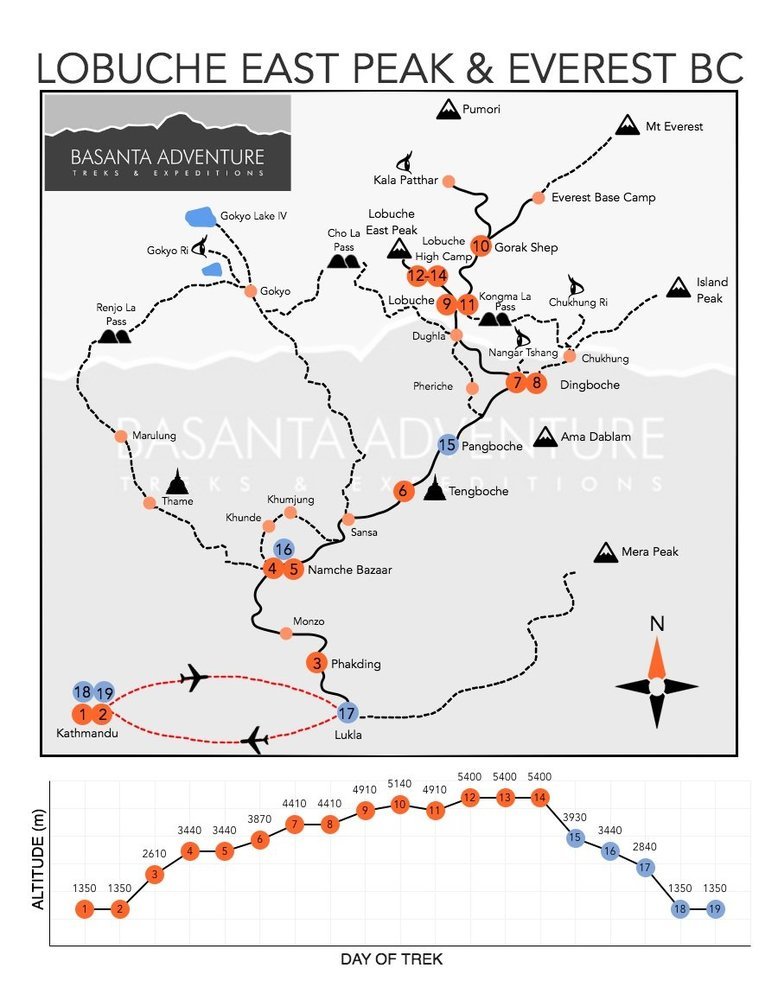
The 20-day Lobuche East Peak and Everest Base Camp Trek combines the classic Khumbu trail with a guided ascent of Lobuche East at 6,119 m. The journey reaches Everest Base Camp and Kala Patthar before shifting into a technical summit climb using ropes, crampons, and ice axes, making it ideal for fit trekkers ready to progress safely into Himalayan mountaineering.
Overview of Lobuche East Peak & Everest Base Camp Trek
The 20-day Lobuche East Peak & Everest Base Camp Trek is designed for trekkers who want to take their Everest adventure beyond the traditional trekking trail. The journey combines the classic route to Everest Base Camp with the ascent of Lobuche East Peak at 6,119 m, one of the best-known trekking peaks in Nepal's Khumbu region.
Unlike a standard Everest Base Camp Trek, the adventure does not finish after reaching Base Camp or climbing Kala Patthar. By that stage, your body has already spent several days above 4,000 m and has gradually adjusted to the thin Himalayan air. The route then turns toward Lobuche East, where the trekking boots, teahouses, and established trails give way to climbing equipment, high camp, snow slopes, and a proper summit attempt.
This combination makes the Lobuche East Peak and Everest Base Camp Trek particularly suitable for physically fit trekkers who already have strong hiking experience and want an introduction to Himalayan mountaineering.
The adventure begins in Kathmandu with a trek briefing, equipment check, and cultural sightseeing before flying into Lukla.
From Lukla, the trail follows the Dudh Koshi Valley through Phakding and Monjo before entering Sagarmatha National Park. Suspension bridges cross the river repeatedly as the trail climbs through forests and Sherpa settlements toward Namche Bazaar at 3,440 m.
Namche is the main trading center of the Everest region and the first important acclimatization stop on the journey.
Rather than rushing higher, we spend an extra day here and take a short hike toward nearby viewpoints. This allows the body to experience a higher elevation during the day before returning to Namche for another night.
From Namche Bazaar, the journey continues toward Tengboche and Deboche.
This section provides some of the most recognizable mountain scenery in Khumbu. Ama Dablam rises prominently above the valley while Everest, Lhotse, Thamserku, and several surrounding peaks remain visible during clear weather.
Tengboche is also home to the famous Tengboche Monastery, one of the most important Buddhist monasteries in the Everest region. Prayer flags, mani stones, monks, mountain villages, and Buddhist monuments give this part of the trail a strong cultural character.
The route then continues through Pangboche toward Dingboche at approximately 4,410 m.
By this stage, the forests have started disappearing. Open alpine valleys, stone walls, dry mountain slopes, and increasingly dramatic peaks replace the greener landscapes found around Namche and Tengboche.
A second acclimatization day is scheduled in Dingboche.
This additional day becomes especially important on the Lobuche East Peak Climbing itinerary because the journey eventually reaches 6,119 m. A short hike above the village allows trekkers to gain elevation gradually and observe how the body responds before moving toward the upper Khumbu.
From Dingboche, the trail climbs through open terrain toward Thukla.
Above Thukla, a steep climb leads to the memorial area dedicated to climbers and Sherpas who lost their lives on Everest and other Himalayan expeditions. From here, the route continues beside the Khumbu Glacier toward Lobuche at approximately 4,910 m.
Lobuche is the point where the trekking and climbing parts of the adventure begin to overlap.
Before turning toward Lobuche East, however, the itinerary continues farther up the Khumbu Glacier toward Gorak Shep and Everest Base Camp.
The walk between Lobuche and Gorak Shep crosses rugged moraine and rocky glacial terrain. Distances appear relatively short on a map, but progress becomes slower because almost the entire journey takes place above 5,000 m.
From Gorak Shep, we continue toward Everest Base Camp at 5,364 m.
The trail follows the edge of the Khumbu Glacier across constantly changing moraine. Reaching Everest Base Camp places you directly beneath the famous Khumbu Icefall and in the environment where Everest expeditions establish their camps during the spring climbing season.
The summit of Everest itself is not clearly visible from Base Camp because surrounding mountains obstruct the view.
That changes the following morning.
Before sunrise, we climb from Gorak Shep toward Kala Patthar at approximately 5,545 m. The viewpoint provides one of the clearest accessible views of Mount Everest from the Nepal side.
Everest rises behind Nuptse with Lhotse, Pumori, Changtse, and other peaks filling the surrounding skyline.
After completing Kala Patthar, we descend toward Lobuche again.
For standard Everest Base Camp trekkers, this would normally signal the beginning of the journey home. For this trip, it signals the beginning of the climbing section.
From Lobuche, we leave the main trekking trail and climb toward Lobuche East High Camp.
The terrain changes quickly. Established village trails give way to rock, moraine, loose scree, snow, and increasingly steep mountain slopes.
Depending on the condition of the route and the final campsite selected by the climbing guide, high camp is generally established at around 5,400 m.
Before the summit attempt, our climbing team checks all equipment and provides practical instruction on the systems that will be used on the mountain.
Trekkers are introduced to crampons, climbing boots, harnesses, helmets, ascenders, carabiners, fixed ropes, ice axes, and safe movement on snow and ice.
Previous mountaineering experience is helpful, but the most important requirements are excellent physical fitness, previous high-altitude trekking experience, confidence on exposed mountain terrain, and the ability to follow the climbing guide's instructions precisely.
Lobuche East is more technical than an ordinary trekking route.
The normal summit approach involves rocky terrain followed by snow and ice sections. Fixed ropes are normally used on steeper parts of the upper climb, where crampons and an ascender help climbers move efficiently.
The summit push begins very early, usually well before daylight.
Starting early allows the team to climb while snow and ice conditions are generally firmer and gives enough time to complete the ascent and descent before afternoon conditions change.
The climb becomes progressively more demanding above 5,500 m.
At this elevation, even simple movements require additional effort. Cold temperatures, limited oxygen, steep slopes, climbing equipment, and the accumulated fatigue of the expedition all influence the pace.
Reaching the summit of Lobuche East at 6,119 m is therefore a completely different achievement from reaching Everest Base Camp.
The summit provides an exceptional Himalayan panorama.
Everest, Lhotse, Nuptse, Ama Dablam, Pumori, Cholatse, and several other mountains dominate the horizon, while the Khumbu Glacier, high valleys, and trekking trails lie far below.
After spending a short period on the summit, the team descends carefully using the same established climbing route.
A contingency day is included around the climbing period because summit conditions cannot be guaranteed.
Wind, fresh snow, poor visibility, unstable surface conditions, or other mountain factors may require the climbing guide to delay the summit attempt. Having a spare day gives the team flexibility instead of forcing an ascent during unsuitable conditions.
After completing the climb, the journey returns to lower elevations through Pangboche, Tengboche, Namche Bazaar, Phakding, and Lukla.
With every day of descent, the air becomes warmer and richer in oxygen.
Glaciers and barren alpine slopes gradually disappear behind you as rhododendron forests, pine trees, rivers, farms, suspension bridges, and Sherpa villages return.
The Lobuche East Peak & Everest Base Camp Trek is classified as a strenuous trekking and climbing adventure.
It should not be treated as an ordinary trek simply because Lobuche East is commonly categorized as a trekking peak.
Participants should prepare for several consecutive trekking days, repeated nights above 4,000 m, a maximum altitude above 6,000 m, cold camping conditions, technical equipment, snow and ice travel, and a long summit day.
Previous trekking experience at altitude is strongly recommended.
Basic climbing experience is useful, but participants who are new to mountaineering can still consider Lobuche East if they have excellent fitness, are comfortable in the mountains, complete proper pre-climb training, and travel with an experienced climbing guide.
Best Time for Lobuche East Peak Climbing
The best time for the Lobuche East Peak & Everest Base Camp Trek is generally during spring from March to May and autumn from late September to November.
These months usually offer the most suitable combination of mountain visibility, trail conditions, operational teahouses, and manageable weather for both trekking and climbing.
Spring is one of the most popular seasons for Lobuche East Peak climbing.
March begins colder, particularly above Dingboche and Lobuche, while April and May normally bring longer daylight hours and relatively warmer daytime temperatures.
The spring season also coincides with Everest expedition activity.
When you reach Everest Base Camp during April or May, the glacier may be filled with expedition tents, climbers, Sherpa teams, and equipment as preparations continue for summit attempts on Everest and neighboring peaks.
Autumn is equally attractive.
The summer monsoon normally clears dust and haze from the atmosphere, creating excellent Himalayan visibility during October and November.
October generally provides the most balanced conditions, although it is also one of the busiest months on the Everest trail.
November offers increasingly quiet trails and sharp mountain views, but temperatures become considerably colder, especially around Lobuche High Camp and during the summit attempt.
Winter climbing is possible for experienced mountaineers, but extreme cold, snow accumulation, and stronger winds can make Lobuche East considerably more difficult.
The summer monsoon is generally less suitable because cloud, rain, poor mountain visibility, flight disruptions, and fresh snow at higher elevations can interfere with trekking and climbing plans.
No climbing season guarantees a summit.
The final decision always depends on current weather, snow conditions, wind, visibility, the health of the climbers, and the judgment of the climbing guide.
Permits Required for Lobuche East Peak & Everest Base Camp Trek
The Lobuche East Peak and Everest Base Camp journey requires both trekking permits and a specific peak climbing permit.
A Sagarmatha National Park Entry Permit is required because the trekking route and Lobuche climbing area lie inside Sagarmatha National Park.
Trekkers also require the applicable Khumbu Pasang Lhamu Rural Municipality entry permit for travel through the Everest region.
The current trekking registration or TIMS requirements applicable to the Everest Base Camp route must also be completed according to regulations in force at the time of travel.
In addition, Lobuche East requires an official peak climbing permit.
Unlike an ordinary Everest Base Camp Trek, reaching the summit cannot legally be undertaken with trekking permits alone. The climbing permit, necessary documentation, guide arrangements, and related climbing formalities must be completed before the ascent.
Basanta Adventure handles the necessary trekking and climbing documentation as part of the operational preparation for the journey.
Why Choose Basanta Adventure for Lobuche East Peak & Everest Base Camp Trek?
Basanta Adventure has been organizing Himalayan journeys since 1998, giving our team decades of practical experience managing trekking, climbing, touring, and high-altitude travel across Nepal and the wider Himalayan region.
Over the years, we have led countless journeys through major trekking regions including Annapurna and Everest.
Our decades of experience leading treks through the Annapurna region have been particularly important in developing the systems we use for high-altitude trekking.
The Annapurna trails have taught our team the importance of realistic walking schedules, proper acclimatization, strong local coordination, dependable porter management, flexible transportation, and experienced guides who understand how mountain conditions affect daily decisions.
Those same principles are applied to a demanding trek and climb such as Lobuche East.
Smooth logistics become especially important when a normal trekking itinerary develops into a climbing expedition.
The journey involves airport transfers, domestic mountain flights, trekking permits, peak climbing permits, lodge reservations, porter support, climbing equipment, high camp arrangements, guides, climbing staff, camping logistics, and weather-dependent scheduling.
Our operations team coordinates these different elements so trekkers can focus on the journey instead of dealing with every logistical detail themselves.
The mountain itself cannot be controlled.
Lukla flights may be delayed by weather. Conditions above Lobuche High Camp may change overnight. A summit attempt may need to move to the contingency day.
Reliable logistics therefore mean more than following a fixed schedule.
They mean having an experienced team capable of adjusting the schedule when conditions demand it without losing sight of safety, acclimatization, and the overall objective of the expedition.
Basanta Adventure is also an ISO-certified company.
Our ISO certification reflects our commitment to organized operations, consistent service standards, responsible management, and professional delivery across the journeys we operate.
We also follow sustainable trekking policies throughout Nepal.
Mountain tourism depends heavily on the landscapes and communities through which we travel. Our approach encourages responsible waste management, sensible use of resources, fair treatment of trekking and climbing staff, respect for local customs, and support for local teahouses, porters, guides, transport operators, and community businesses.
These responsibilities are particularly important in the Everest region, where high visitor numbers place increasing pressure on fragile alpine environments.
Our guides encourage trekkers to reduce disposable waste, avoid unnecessary damage to trails and vegetation, respect local religious sites, and travel responsibly through Sagarmatha National Park.
Beyond Nepal, Basanta Adventure is also recognized for its long experience organizing tours, treks, and expeditions in Tibet.
Operating in Tibet has given our team additional experience with remote logistics, high-altitude travel, changing weather, expedition planning, and the practical challenges of moving groups through some of the highest inhabited landscapes in the world.
This wider Himalayan experience adds another level of understanding to the way we organize demanding Nepal climbing adventures.
For the Lobuche East Peak & Everest Base Camp Trek, our responsibility is clear.
We provide the logistical structure, experienced staff, climbing support, realistic acclimatization, permits, equipment coordination, and local knowledge needed to give climbers the strongest possible platform for a safe and rewarding journey.
The summit can never be promised.
A professional and carefully managed expedition can.
What is included in the tour
Kathmandu Portion:
- 4 nights in reputed 3 star Hotel on BB basis as per the itinerary in Kathmandu
- Half day guided sightseeing tour of Kathmandu
- 1 professional English speaking guide
- Private transportation during sightseeing
- All entrance fee during sightseeing
Transportation:
- All the necessary airport transfers as per the itinerary
- Air fare: Kathmandu – Lukla – Kathmandu
Trek Portion:
- Twin sharing accommodation on EP ( room only) basis as per the itinerary in lodge en-route
- Twin sharing accommodation on AP (Full Board) basis as per the itinerary during camping only
- TIMS Card
- EBC National park fee
- Pasang Lhamu village development fee
- Professional licensed holder Trekking guide
- Assistant Guides as per number of clients
- Necessary Porters (weight max. 12 kg per clients)
- Insurance for Nepali staffs
- Necessary equipment for trekking staff
- Guide and porter daily allowance
- Emergency medical kit box
- Trekking kit bag
Climbing Portion:
- Climbing permits
- All meals during camping
- All camping, Kitchen and all climbing equipments
- Day climbing training
- Services of Climbing Guide and Porters (yak).
- Climbing allowance and equipment fee for Climbing Guide
- Climbing Guide insurance
- Kitchen crew and their insurance.
What is NOT included in the tour
- Nepal Visa fee
- Any meals (Breakfast, Lunch, Dinner and Tea/Coffee) during trek
- Travel insurance (must cover expenses of rescue service including helicopter)
- Climbing boots ( you can hire at Namche that would cost about $ 5 per day)
- Lunch and dinner in Kathmandu
- Liquor beverages (soft and hard drinks)
- Expenses of personal nature e.g. laundry, phone call etc.
- Gratuity for staff
- Expenses incurred due to unforeseen circumstances
- Services not mentioned herein
- Summit Lobuche East Peak at 6,119 m/20,075 ft and experience the transition from high-altitude trekking to a genuine Himalayan climbing adventure
- Reach Everest Base Camp at 5,364 m/17,598 ft and walk beside the Khumbu Glacier beneath the famous Khumbu Icefall
- Climb Kala Patthar at approximately 5,545 m/18,192 ft for one of the clearest close-range views of Mount Everest
- Learn and use basic mountaineering skills, including crampon movement, fixed-rope climbing, harness use, ascenders, ice axe handling, and safe descent techniques
- Trek through famous Sherpa settlements including Namche Bazaar, Tengboche, Dingboche, Lobuche, Pangboche, and villages along the Dudh Koshi Valley
- Visit Tengboche Monastery and experience the Buddhist culture, prayer walls, chortens, monasteries, and mountain traditions of the Khumbu region
- Enjoy extraordinary summit views toward Everest, Lhotse, Nuptse, Ama Dablam, Pumori, Cholatse, and the surrounding Himalayan ranges
- Follow a gradual acclimatization itinerary with additional days in Namche Bazaar and Dingboche before climbing above 6,000 m
|
Days |
Itinerary |
Overnight |
|
01: |
Arrival in Kathmandu and transfer to Hotel |
Hotel (BB) |
|
02: |
Trek briefing and half day sightseeing tour of world heritage sites |
Hotel (BB) |
|
03: |
Fly to Lukla and trek to Phakding, (2610m/8560ft), 3-4 hrs |
Lodge (EP) |
|
04: |
Trek to Namche Bazaar, (3440m/11283ft), 5-6 hrs |
Lodge (EP) |
|
05: |
Acclimatization day at Namche bazaar |
Lodge (EP) |
|
06: |
Trek to Tengboche, (3870m/12694ft), 6 hrs |
Lodge (EP) |
|
07: |
Trek to Dingboche, (4410m/14465ft), 6 hrs |
Lodge (EP) |
|
08: |
Acclimatization day at Dingboche |
Lodge (EP) |
|
09: |
Trek to Lobuche, (4910m/16105ft), 6 hrs |
Lodge (EP) |
|
10: |
Trek to Gorakshep – EBC (5364m) – Gorakshep, (5140m), 8 hrs |
Lodge (EP) |
|
11: |
Trek to Kalapathar (5545m/18192ft) and back to Lobuche, 7-8 hrs |
Lodge (EP) |
|
12: |
Trek to High Camp (5400m / 17712 ft), 3-4 hrs |
Camp (AP) |
|
13: |
Lobuche Peak Summit(6119m) and back to High Camp, 8-10 hrs |
Camp (AP) |
|
14: |
Extra Summit Day |
Camp (AP) |
|
15: |
Trek to Pangboche (3930m /12900 ft), 8-9 hrs |
Lodge (EP) |
|
16: |
Trek to Namche Bazaar, 4 – 5 hrs: |
Lodge (EP) |
|
17: |
Trek to Lukla (2840m/9315ft), 6 – 7 hrs: |
Lodge (EP) |
|
18: |
Fly to Kathmandu. |
Hotel (BB) |
|
19: |
Free day in Kathmandu |
Hotel (BB) |
|
20: |
Holiday extension or final departure |
--- |
Detailed Itinerary:
Day 01: Arrival in Kathmandu (1300m/4265ft):
Arrival in Kathmandu greeted by Basanta Adventure representative and transferred to Hotel which is usually a walking distance to any good restaurants and shops. We will be given a short briefing on hotel facilities and safety as well as a short introduction to the area. Next day there will be a comprehensive trip briefing. O/N in Hotel at Kathmandu (BB)
Day 02: Trek briefing in the morning and sightseeing tour of world heritage sites:
After breakfast, trek briefing will take place around 9 am. All aspects of gear and conditions are discussed to make sure you are fully prepared for the trip, introduce guide and any last-minute questions would be answered. We then visit Boudhanath, also known as little Tibet. Then we visit Pasupatinath one of the revered holy temple of the Hindus, this temple is also known for its cremation ceremonies that take place next to the holy river Bagmati. O/N in Hotel at Kathmandu (BB)
Day 03: Fly to Lukla and Trek to Phakding (2610m/8560ft), 3-4 hrs:
Take the morning flight, a thrilling experience to the dramatic airfield at Lukla (2,860m) where we are immediately in amongst the peaks. We will be welcomed by rest of the trekking crew in Lukla airport. The sudden change in altitude can leave some of us quite breathless, but we descend to Chaplung (2680m) before lunch to let ourselves acclimatize more gradually. The afternoon is an easy introduction to the trek up the beautiful Dudh Koshi river valley, passing huge carved mane stones and prayer wheel shrines, to our night lodge at Phakding. The lodges on the first half of the trek are good: twin rooms with comfortable mattresses and nice cozy dining rooms with stoves for cold weather days. The menus include all sorts of wholesome favorites: pasta, noodle and rice dishes with remarkably fresh vegetables, puddings and every variety of hot drinks. The lodges have the same pattern all the way up, but understandably they become a bit more simple right at the top of the trek - though still remarkably good for the location. We always select the best of the standard lodges in each night stop. O/N at Lodge in Phakding (EP)
Day 04: Trek to Namche (3440m/11283ft), 5-6 hrs:
Through blue pine and Rhododendron forests we continue gradually upriver to reach Monzo at the entrance to the Sagarmatha (Everest) National Park. Just beyond, after crossing the river on one of the excellent new pedestrian metal suspension bridges, these are the lifeline of mountainous region; we take lunch at one of the tea houses that line the banks at Jorsale (2775m). So far our gain in height has been barely perceptible, but the afternoon sets us a fairly tough challenge, exaggerated by the early stage of our acclimatization. Rising first to cross a marvelous bridge high above the Imja Khola, we then gradually ascend the ridge opposite. And halfway up, we should be able to look out for our first view of Everest ahead. We must also look out for pack-yaks which we will see from now on; generally good natured, we should still keep up-side of these huge beasts - avoiding a playful nudge! We arrive at Namche Bazaar, the Khumbu district capital, built within a natural amphitheatre setting surrounded by peaks, and now a thriving lodge town. O/N at Lodge in Namche (EP)
Day 05: Acclimatization day at Namche:
The first of our carefully planned days to allow us to acclimatize naturally. There is plenty to do and explore around Namche, including the Sherpa museum above the village, hike up to Thyangboche etc. O/N at Lodge in Namche (EP)
Day 06: Trek to Tengboche (3,870m/12,694ft), 5- 6 hrs:
After breakfast, we trek towards Tengboche. It is an easy walk from Namche to Phunki. Upon reaching Phunki, we ascend towards Tengboche, a village that houses the very famous Tengboche monastery which is the largest monastery of the Everest region. Located amidst the Sagarmatha National Park (a UNESCO World Heritage Site of "outstanding universal value”), the most sacred and popular monastery of Everest region where every climber receive blessing from high monk before expedition it is draped with the panoramic 360-degree view of the Himalayas, including Mt. Everest, Nuptse, Lhotse, Ama Dablam and Thamserku. The monastery opens at 3pm so we reach it by three. And, if we are lucky, we might just be able to witness a religious ceremony. O/N at Lodge in Tengboche (EP)
Day 07: Trek to Dingboche (4410m/14465ft), 5-6 hrs:
We visit the beautiful Tengboche Monastery in the morning and take pictures of the amazing landscape surrounding it. Then we begin our trek by walking through lush forests of birch, conifers and rhododendrons on an easy path. This picturesque trail then dips down to Debuche, crossing the Imja River before climbing up to Pangboche. (We can either walk in the upper or lower Pangboche trails). We are most likely to choose the upper Pangboche trail as it provides a more pristine view of the Himalayas. We also visit the Pangboche monastery. From here, the walk is fairly moderate as we enter the Imja Valley. The valley gradually unfolds as we approach the confluence of the Lobuche River, O/N at Lodge in Dingboche (EP)
Day 08: Acclimatization day at Dingboche:
After breakfast we begin today’s hike to Chhukung by walking through stone-walled fields, Imja Khola valley before walking in glacier moraines. We will be surrounded by Lhotse and one of the most beautiful mountain of Everest regions Ama Dablam Peak. Later, beyond Bibre village we see Island Peak towering above us. The trail ahead is intersected by icy streams. We reach Chhukung, a small settlement in about half an hour from Bibre. From here, directly across the valley is the fantastic view of Ama Dablam and the Amphu Labsa mountains. After having lunch in Chhukung, our climbing leader will check our items of equipment in order to make sure that they are in a good working condition. Chhukung is the best place for hiring equipment for Peak climbing. We descend to Dingboche to spend the night. O/N at Lodge in Dingboche (EP)
Day 08: Trek to Lobuche (4910m/16105ft), 6 hrs:
Today we start our final approach to the base camp area. It’s easy enough to start with, as we round the ridge above Dingboche by a single chorten, and contours along wide grassy slopes all the way to Thugla (4595m) our lunch stop. Then we climb steeply up the terminal moraine at the snout of the Khumbu glacier, until we come out alongside it at a ridge lined by hundreds of cairns dedicated to the many Sherpas who have lost their lives in attempts on Everest and other peaks. We continue alongside the glacier finally crossing what is now no more than a stream to Lobuche our lodge stop. There are limited individual rooms available here and in peak season we sometimes have to fall back on sleeping in the still very comfortable dormitory of the best lodge. O/N at Lodge in Lobuche (EP)
Day 10: Trek to Gorak Shep and visit Everest Base Camp (5140m/16859ft), 6-7 hrs:
We take the trail to Everest Base Camp through the once vast Gorak Shep Lake. Continuing straight ahead, we come across the Indian army mountaineers' memorials. The path from here can be misleading; hence it is important that we follow our lead Sherpa attentively. The walk is strenuous due to thin air in the high altitude. We pass through rocky dunes, moraine and streams before reaching the Everest Base Camp. Upon reaching the Everest Base Camp, we see tents of mountaineers that stand out in bright colors against the monotony of gray surroundings (especially in the spring). Nuptse, Khumbuste and Pumori are the mountains we can view from the base camp. We get back to Gorak Shep for a good night's rest.
Your guide will organise a prayer and offer Lungta (Prayer flags) for good health and happiness for all the members. O/N Camping in Classic Base Camp (AP)
Note: Offer Lungta or prayer flags (printed prayers for the peace and good health/happiness) together with our Guide. Offering prayer flag in high passes and sacred sites is believed to bring good fortune and long life in Buddhist culture.
If weather is clear, we should take our chance and go up to Kalapathar for excellent closed up view of Everest, Nuptse and Lhotse. Sunset on Everest from here is pure magic, gold to pink catching the tips of the peaks, subtly fading with the light - worth every effort. It turns very cold after losing the sun - wrap up in everything you brought, down jacket and all. Don't forget your head-torch for the descent. O/N at Lodge in Gorakshep (EP)
Day 11: Trek to Kalapatthar (5545m/18192 ft) and Trek back to Lobuche (4910m/16105ft), 7-8 hrs:
We prepare for an early morning departure, amid pre-dawn darkness and cold temperatures (-10 to -14 C). Plus, there is always the potential for chilly winds which are quite common. Familiar peaks such as Lingtren, Khumbutse, and Changtse tower to the east even as Everest begins to reveal itself. For those who wish to trek to Kalapathar Peak for the for excellent 360-degree up-close and formidable views of Mt. Everest and other highest peaks. We take pictures, enjoy the magnificent mountain panorama. Later trek down to Lobuche. O/N at Lodge in Lobuche (EP)
Day 12: Trek to High Camp (5400m/17,712ft), 3-4 hrs:
From Lobuche, we trek towards Lobuche base camp. After walking some distance on relatively flatter plane, the path to the Lobuche Base Camp gets steeper and rocky. We move forward along the Lobuche Glacier while enjoying great views of Ama Dablam, Cholatse, Pokalde, Thamserku, Kantega and other Himalayas. From the base camp, we continue on a rocky moraine path to reach the High Camp. After reaching there, we set up our camp, take lunch and rest. For the climb, we usually will be climbing on rock surface for up to around 5770m. After that, we climb on ice and use ropes when necessary. However, the use of the rope and the length depends upon the season and the crevasses. Fixed rope is used most of the times whereas man rope is used when required. The climbing leaders will decide what is best for when. Overnight in Lobuche East High Camp. Pre-Climb Training: Our guides will provide training on peak climbing techniques and the proper ways of using climbing gears such as the ice axe, climbing boots and crampons, harness, ascender, etc. The training will also include using ropes to go up and down. We strongly believe that the training experience will boost your confidence and climbing skills to increase the chances of scaling the summit as well as to fully enjoy the experience. O/N at camp in High Camp (AP)
Day 13: Summit day (6119m/20, 075 ft). Return to High camp, 8-10 hrs:
We wake up early today at around 12 to 1 am and have our breakfast before beginning our climb. It is important we reach the summit before noon because in the afternoon the strong winds in the high lands might become a barrier for a successful summit. We will most likely be walking on rock surface up to around 5700m after which we climb on ice. We use both fixed rope and man rope as per our leader’s instruction. The climbing surface as well as the length of the rope and depends on the time of the season and the crevasses. Lobuche East offers more panoramic views of the mountains than any other trekking peak. From the summit, you get to enjoy magnificent views of Everest, Lhotse, Nuptse, Ama Dablam, Cholatse, Pumori, and many more. We spend some time at the summit celebrating and taking pictures, then we get back to the High Camp again for an overnight stay. O/N at camp in High Camp (AP)
Day 14: Extra Summit Day:
There is no such thing as a guarantee of good climbing conditions in the Himalayas, so an extra day maximizes our odds in this normally fair-weather season. If we've done the deed already, we'll decide whether to rest up or move on down. O/N at camp in High Camp (AP)
Day 15: Trek to Pangboche (3930m/12900ft), 8-9 hrs:
After taking our morning breakfast, we trek downhill from Lobuche High Camp and join the Everest Base Camp route at Lobuche again. We take our lunch at Lobuche. From Lobuche we again retrace our path to Pheriche. On the way to Pheriche, we get to enjoy magnificent views of Mt. Ama Dablam in the distance. From Pheriche, we trek down through the hillside blanketed by rhododendron and juniper trees. If it's spring, pink and red rhododendron flowers ablaze our surroundings. Upon reaching Pangboche we may also consider visiting the famous Pangboche Monastery. O/N at Lodge in Pangboche (EP)
Day 16: Trek to Namche bazaar (3440m/11283ft), 5-6 hrs:
From Pangboche, we retrace our steps down to the Imja Khola and up through the forest to Tengboche. If interested, we can also visit nuns at the Tengboche monastery. After lunch at Tengboche, we continue through the hillside blanketed by rhododendron and juniper trees. After crossing the bridge over the Dudh Koshi River, our trail follows the Dudh Koshi gorge descending rapidly through the pine forests before reaching Sansa. We keep a lookout for wildlife such as mountain goats, colorful pheasants etc., while passing through the forest. After passing a chorten, remember to take clockwise of any sacred monument as a respect to local culture. We reach the army camp at Namche Bazaar. O/N at Lodge in Namche Bazaar (EP)
Day 17: Trek to Lukla (2840m/9315ft), 6-7 hrs:
Steeply down the ridge again to the suspension bridge, we follow the river down the way we came up, as far as Phakding for lunch. In the afternoon we continue down to Lukla. This will be the last night with our trekking crew except trekking Guide, this is best time to tip the staff (not compulsory but it’s a customary), an impromptus little ceremony and always enormous Sherpa smiles. Then something of a party is inevitable. Try local drink called “Rakshi”, please be aware; it does not taste good and is very strong. O/N at Lodge in Lukla (EP)
Day 18: Fly Lukla to Kathmandu, 30 minutes flight:
The flight time to Kathmandu, are schedule for morning normally, because of the wind in the afternoon, sometime the flight time can be delayed due to bad weather and other reason beyond our command. Anyway we will fly back to Kathmandu. We will be met by Basanta Adventure representative and transferred to hotel. Upon arrival in Kathmandu, any hire gears will be collected. O/N at hotel in Kathmandu (BB)
Day 19: Day at leisure:
This pleasant day you may have full day at leisure and either relax at hotel or explore Kathmandu city, shopping etc. Kathmandu offers varieties of Restaurants and Fast-Foods for food lovers. O/N at Hotel in Kathmandu (BB)
Day 20: Holiday extension or transfer to airport for final departure:
Today holiday extension for another tour or transfer to the airport for final departure. Tour concludes.